


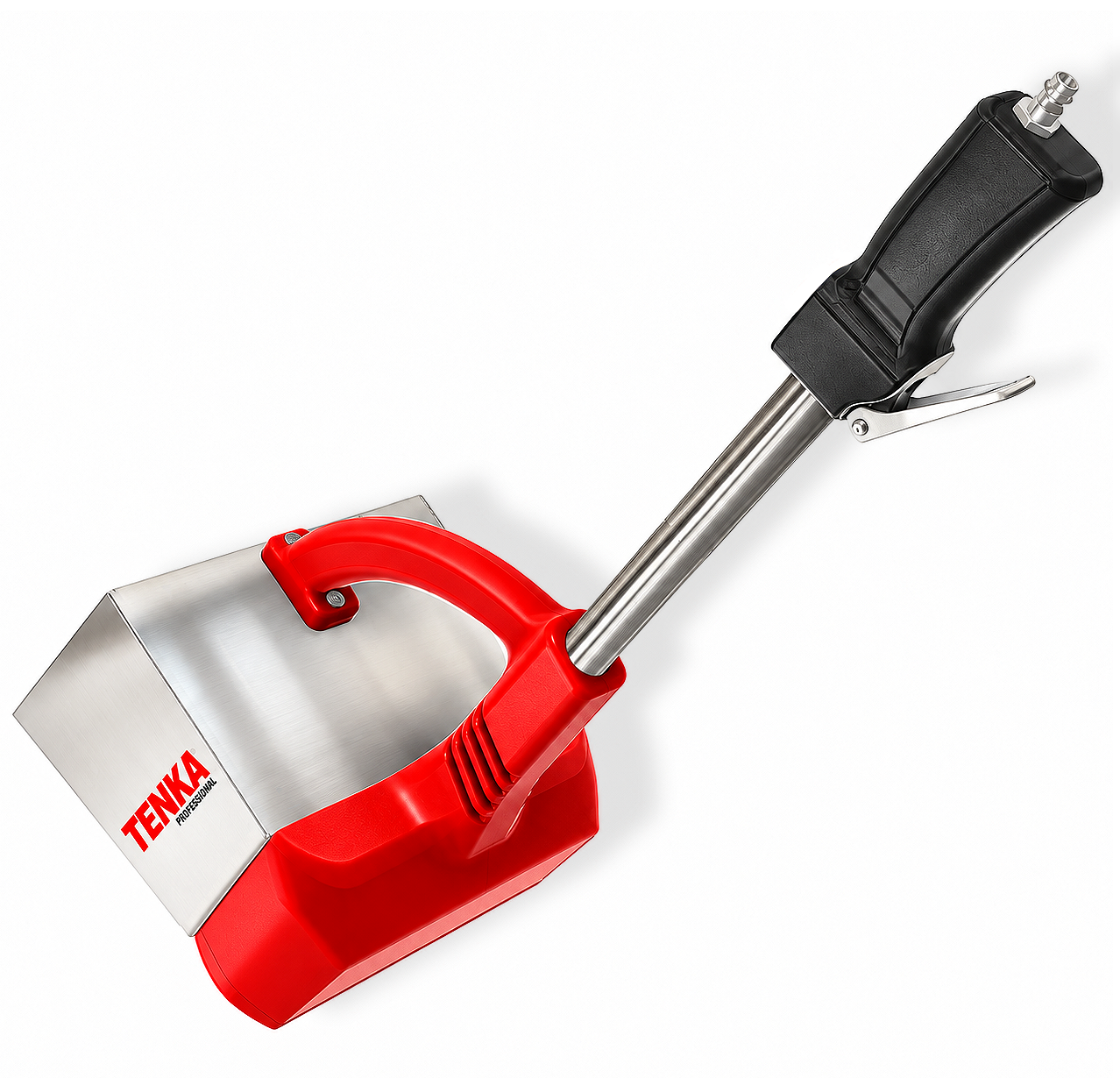
Pneumatic Mortar Sprayer with 5 Lockable Nozzles (3 Wall + 2 Ceiling)
This pneumatic plastering gun features 3 parallel nozzles for wall plastering and 2 upward-angled nozzles for ceiling plastering or horizontal reinforcement filling. All nozzles can be locked, unscrewed, and cleaned very easily and quickly without the need for wires, cleaning drills, or other tools.
Product details
The ergonomic design is intended to ease the workload and minimize physical effort. Thus, the weight-bearing handle is fixed in a vertical position to transfer the effort to the arm muscles (biceps) and reduce strain on the neck and back muscles.
The metal hopper is equipped with a 2 cm rim to prevent material spillage when the plastering gun is tilted. The aluminum hopper has a loading capacity of approximately 5 kg of mortar, equivalent to about 3 full hand trowels. The hopper volume was calculated to provide a balance between operator effort and work efficiency.
Quick Connection and Easy Use
The pneumatic gun is equipped, in addition to the manual horizontal trigger, with a universal "male" quick coupler, so that the pneumatic hose can be connected or disconnected very easily and quickly.
Durable Materials and Low Weight
The materials used were chosen to combine durability with the lowest possible weight. The TENKA 5-nozzle plastering machine weighs only 2.9 kg, which facilitates its use during plastering works.
The pneumatic manifold is made of hard polyurethane with threaded metal inserts at the outlet channels, and the support handle is strong and robust.
Individual Nozzle Control with Locking Caps
The locking caps are mounted and dismounted very easily, without requiring tools for tightening or threading. Each cap blocks both the respective nozzle channel and the corresponding orifice through which air is exhausted and material is dispersed.
Thus, the operator can configure the gun according to the work being performed. For plastering vertical walls, one, two, or all three dedicated wall nozzles can be used, and for plastering ceilings, one or both upward-facing nozzles can be used.
Recommended Air Pressure and Flow
It is not recommended to use more than 3 nozzles simultaneously. In the case of an available pressure of 10 bar distributed simultaneously to 4 outlets, the resulting theoretical pressure would be approximately 2.5 bar per nozzle, which is insufficient for efficient mortar projection.
To project mortar at a distance of at least 30 cm, a working pressure of at least 3 bar/nozzle and an air flow of at least 80 l/min/nozzle are required. The compressor used must be chosen so that it can simultaneously provide the pressure and flow required for the number of nozzles used.
Plastering Gun Applications
The applications of this plastering device are numerous. These include:
- Filling swimming pool walls reinforced with welded mesh, including by concentrating pressure on a single nozzle using the locking caps included in the package.
- Filling ceilings with traditional plaster, finishing coats, or other compatible materials.
- Filling and complete plastering of walls made of brick, AAC (Autoclaved Aerated Concrete), stone, clay, straw, welded mesh, etc.
- Filling straw walls or other natural reinforcements.
- Applying a spatter dash (stipple) coat to improve mortar adhesion.
- Filling and shaping well stones and fences that mimic the appearance of natural mountain stone.
- Applying skim coats, finishing plasters, and other similar materials.
CNC Machined Pneumatic Manifold
The pneumatic manifold is precision-machined using CNC technology for the correct creation of the channels and functional areas of the pneumatic system.
The manifold is equipped with threaded metal inserts at the outlet channels for mounting the nozzles and locking caps. The support handle is strong and robust, designed for use in conditions specific to construction work.
Package Contents
The package contains: the TENKA plastering gun equipped with 3 nozzles and 2 mounted caps, an additional 2 locking caps for individual control of the mortar discharge orifices, the invoice, the warranty certificate, and the technical instructions for use.
At the customer's request and depending on stock availability, the package can be supplemented for an additional cost with extra accessories, such as a pneumatic hose at the length desired by the customer or a spare accessory pack that may include pneumatic nozzles and locking caps.

Questions, comments and opinions
Questions and experiences shared by customers and users.
Add comment
Share your question, experience or opinion.
At one point, something broke on the flow gun. I called and the next day I received the part for free. 2 out of the 3 wall nozzles got clogged and I called to send it in for unclogging. They told me the unclogging is free, but it's a shame to be without it for 3 days. Over the phone, they taught me how to unclog it.
The other day I took on another plastering job and remembered the plastering machine. I sent it to them to unclog it again. It was so badly clogged that they couldn't unclog it. And I received an offer to replace the hopper and that area with the holes with other parts.. The price? Free! Hard to believe, but that's the truth.
Only after you have sprayed the lime-free spatter coat (only cement + sand) can you load the mortar in thin layers over the metal reinforcement.
The mortar will coat the reinforcement mesh and create a strong mass anchored into the old slab.
Option 2: if the slab in the photo is already strong enough, you can attach wooden beams with metal brackets over the current steel profiles, and on them build the metal framework for plasterboard.
I assume you already have the structural slab above (as seen in the photo) and you want to load it for finishing. Otherwise, ignore everything I wrote above and consult a structural engineer. There are solutions for everything.
Example here
Use classic mortar (multibat with sand or cement + sand + lime) with coarse sand .. 0.4-0.5 (from a gravel pit).
Tip: if you use welded mesh or steel of any kind, do not use lime in the mortar composition. make the plastering only with sand and cement. 6 shovels of sand + 1 of cement
So if you work at a relaxed pace in 2 people, we assure you that a compressor with a 50 liter tank, 8 bar pressure, and a minimum intake flow of 270 liters/minute is sufficient. The recommendation is for it to have 2 pistons rather than one.
You have here a video from one of our customers with a 50 liter / 8 bar compressor with a single piston.
Here is here also a compressor model with 2 pistons.
If you work in a team (one loads continuously, another levels with the straightedge, another carries bags, another mixes, etc.), the 50 liter compressor will drop the pressure to 5-6 bar and will not be able to keep it constant at 7-8 bar as it should.
In that case, a 100 liter compressor is necessary because its motor has the capacity to charge the tank faster at a constant pressure of 7-8 bar.
The nozzles of the plastering guns are calculated very precisely to fit within the parameters of these compressors. If I am not mistaken, the nozzle diameter is 2.35mm.
If you don't add enough cement, the mortar will bounce off the wall and won't set. You'll lose it on the floor.
If you add too much cement, the mortar becomes too sticky and hard to throw even with a hand trowel.
If you use classic plaster (sand + cement + lime), use the 6+1+1 ratio (6 shovels of sand, 1 shovel of lime, 1 shovel of cement) or a multiple (12+2+2). If you have rebar in the plaster for reinforcement, do not use lime in the mortar recipe because the iron will oxidize and you will have a rust stain that will always come to the surface of the wall.
TIPS:
- DO NOT leave the device in the water you washed it in because the cement water will penetrate the device and can harden.
- After washing the device, leave it in clean water during your work break.
- When unscrewing the nozzles to clean them, make sure the plastering machine is washed and clean.
- Also buy the pack of spare nozzles.
Soon we will update the models with a filter to stop all the dirt from the hose at the quick coupling of the plastering machine and to get rid of cleaning the nozzles. It is being worked on and will be released on the market as soon as possible. The filter will be placed at the entrance of the trigger's quick coupling and will retain any impurity in it, keeping the nozzles clean at all times.
Usually, the nozzles get clogged only at the beginning during the first use because the compressor sweeps all the dirt from the circuit (hose+lance+manifold).
You have included instructions with images regarding the cleaning of the nozzles.
I built a garage, and not being a professional, the walls weren't exactly straight, so I had to apply quite a thick layer when plastering. This is how it looks at the end: PHOTO
Length as long as possible so you don't stay close to the compressor. Between 20 - 50m
If the hose diameter is 6mm, there is a risk of it getting clogged with pebbles or rubber, reducing the cross-section and implicitly the airflow.
If the diameter is larger than 8mm, the hose becomes rigid and difficult to handle. You will trip over it on the construction site.
If the hose length exceeds 50 meters, a delay occurs when pressing the trigger. The hose equalizes its pressure with the compressor tank more slowly.
These black guns are the newest and most updated. They are completely molded from Polyamide (PA66), a very hard plastic. They are tested at high pressures and resist friction and repeated movement.
The previous brass guns used to break sometimes, but with these polyamide ones, not even one has ever broken. They are less aesthetic but much more resistant. We are sticking with them.
Sometimes the O-rings (those small gaskets) break, but you have several spare gaskets included in the package. Additionally, you can buy from us anytime. You can find them here
Attention! The gun with the trigger at the end of the lance only works in pneumatic mode between 7 and 10 bar. If you put 5 bar into the device, the gun will not close the circuit because all the parts inside (valves, gaskets, etc.) settle into their positions based on pressure. It is normal that when you blow with your mouth, it doesn't block the air. All devices do this. Connect it to the compressor at 8 bar and it will work perfectly.
Approximately 400 sqm per day are applied by one person. I want to mention that on the first day we used very fine sand and it went very poorly. I thought the plastering machine was at fault. Then we switched to coarse-grained sand (0.4m) and it works superbly. I'll make a video.
So, for a compressor to work without issues in a hobby setting (meaning if you are plastering your own house at a relaxed pace), you need a minimum intake flow rate of 250 l/min, a pressure of 8-9 bar (never exceed 9 bar), and an air tank of at least 50 liters.
Ideally, it should have 2 pistons instead of just one. For 2-piston engines, the flow rate is double (400l/min) and the engine manages to fill the tank much faster and sometimes take a break.
If you work in a professional setting, meaning with a team (one at the concrete mixer, another loading, another using the straight edge), you need a compressor with a 100-liter tank, the rest of the parameters remain the same (flow rate, pressure, etc.).
If you already have a smaller compressor and do not wish to invest in a more powerful one, you can use the Tenka machine with only 2 nozzles. You block the rest of the nozzles; some blocking caps are included in the package. With 2 nozzles, the machine loads up to 2 cm of plaster thickness in a single second if you hold it in position. So it is quite fast even with 2 nozzles. The excess pressure will be released from under the gun trigger.
In case of a malfunction, my colleagues will find you in the database without asking for any document, invoice, or certificate. If the extended warranty is written on the invoice, that is enough. The clauses are identical to those in the warranty certificate, except that the validity is extended through the invoice.
I sent you a print screen. Can anything still be done? Thanks
2. 3-year warranty + fast service (from one day to the next)
3. Can be used for spatter coats, can work with MP plaster (with a single nozzle)
4. Ceilings can be plastered easily due to the upward-angled nozzles.
5.The nozzle threads are metallic and not plastic.
6.The hopper support handle is cast (solid). In 5 years, not a single broken handle has ever returned for warranty or service.
Tip: wherever you want to buy a plastering machine from (China, Italy, Romania), keep 3 essential things in mind.
1.It should have lockable nozzles so you can work with a maximum of 3 nozzles and be able to apply the spatter coat (spritz) with one nozzle. With 4 nozzles, you need a serious compressor. Note: spatter coat does not mean cement milk or that watery mixture applied with a trowel on the wall. Spatter coat means mortar sprayed like a grain of rice (it should scratch if you touch it with your palm). This creates maximum adhesion with the thick plaster. And a bonus secret: the spatter coat should not be allowed to dry completely, but partially. Load the plaster over the spatter coat while it is still semi-wet so that the contact bond is both mechanical and chemical.
2. The handle that holds the weight of the mortar hopper should be vertical (meaning upright and not horizontal). If it is horizontal, all the effort is discharged into the shoulders, neck, and back. If it is vertical, it only strains the biceps (arm muscle) and the neck is relaxed. After a day of plastering, this detail matters. Take a dumbbell or a bottle of wine and lift it with your fist horizontal and then vertical. You will perfectly understand what I am saying.
3. Warranty, service, and consultancy should be fast. For example, we resolve service issues via courier in 24-48 hours because we know what it means to block work on the construction site. If a nozzle gets clogged on the site, for example, you don't sit around filling out emails and online forms, but you call the phone number written on the machine and in 3 minutes a colleague explains how to unclog it. It's a minor detail, but believe me, it matters in practice.
The ones with 3 nozzles will be discontinued soon.
Tip: buy at least 15 - 20 meters of hose to keep the compressor at a distance. The noise of the compressor causes irritation and stress after a day on the construction site.
The maximum recommended length of the hose is 50m. If you exceed this length, a half-second delay will occur from the moment you pull the gun trigger because the hose will equalize its internal pressure with that of the compressor tank. And the volume of the hose is already large at a length of over 50m, which causes the delay to appear. The hose must be fitted at one end with a male quick coupler (approx. 4 lei) and at the other end with a female coupler (12 lei). Or you can find it already fitted in Dedeman (approx. 50 lei) So:
- Inner diameter 8mm
- Hose length minimum 15m.
- At one end a male quick coupler and at the other end a female coupler example : here
Take the respective mortar with a trowel and turn the trowel 90 degrees. All the mortar must fall off the trowel. If it stays stuck to the trowel, it means that the plastering machine won't be able to throw it completely onto the wall either, and there will be waste.
This problem usually occurs with machine-applied plasters that contain additives and plasticizers to make them more pasty so they flow through the hose more easily. That's why they are also stickier. But if your plaster passes the trowel test, the plastering machine should also throw it perfectly.
You can find the test I'm telling you about in this video at minute 1.55.
Since many customers ask about this, I asked my colleagues from the technical department for a clear table with the compressor tests. The table can be found here
The model with 5 lockable nozzles includes the 3-nozzle one in its design, as it is built on the same chassis, but the pneumatic manifold has been updated with 2 more nozzles angled towards the ceiling. It is very possible that the 3-nozzle one will be discontinued for this reason. The 5-nozzle one is practically universal. All nozzles can be locked/unscrewed/cleaned. (you have instructions with images)
The warranty is 3 years for both models, so the choice is purely subjective.
The most commonly used and cost-effective mortar: link mortar
Cheap compressor (hobby) but tested by us on the 3-nozzle model: link compressor
Use sand with a grain size as large as possible: 0.3 - 0.4 mm
Other mortar recipes can be found in the instructions in the package. Good luck with your work and God bless.