


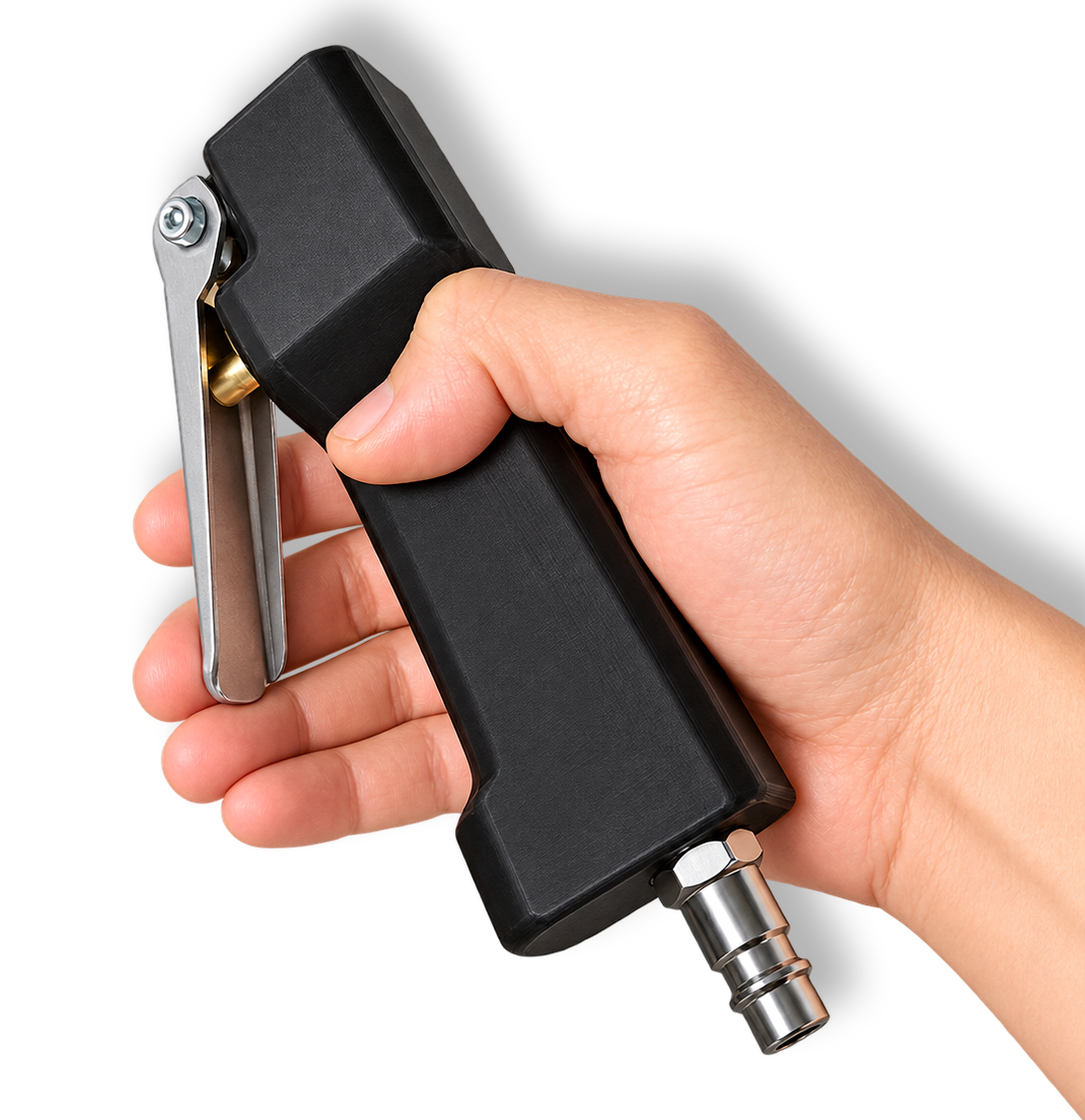
High-flow pneumatic air gun with valve for TENKA plastering machines
TENKA pneumatic air gun with protection valve and high flow, specifically designed for use with TK-51 and TK-51N plastering machines. Its construction allows efficient air supply to the pneumatic system and provides quick and convenient control via the trigger.
Product details
TENKA pneumatic air gun with protection valve and high flow, specifically designed for use with TK-51 and TK-51N plastering machines. Its construction allows efficient air supply to the pneumatic system and provides quick and convenient control via the trigger.
The gun is equipped with a safety valve located under the trigger, designed for the automatic discharge of excess air from the system. This system is particularly useful when the air flow supplied by the compressor is higher than what is actually consumed by the active nozzles.
Due to the increased air flow, the gun is suitable for TENKA models with multiple nozzles, where simultaneous and constant supply to the pneumatic system is required. The trigger allows for quick starting and stopping of the air flow, providing the operator with good control during mortar application.
The robust construction, quick connection to the pneumatic system, and the overpressure discharge system make this gun a practical solution both for replacing the original gun and as a spare part for users of the TK-51 and TK-51N models.
Questions, comments and opinions
Questions and experiences shared by customers and users.
Add comment
Share your question, experience or opinion.
Use classic mortar (multibat with sand or cement + sand + lime) with coarse sand .. 0.4-0.5 (from a gravel pit).
Tip: if you use welded mesh or steel of any kind, do not use lime in the mortar composition. make the plastering only with sand and cement. 6 shovels of sand + 1 of cement
So if you work at a relaxed pace in 2 people, we assure you that a compressor with a 50 liter tank, 8 bar pressure, and a minimum intake flow of 270 liters/minute is sufficient. The recommendation is for it to have 2 pistons rather than one.
You have here a video from one of our customers with a 50 liter / 8 bar compressor with a single piston.
Here is here also a compressor model with 2 pistons.
If you work in a team (one loads continuously, another levels with the straightedge, another carries bags, another mixes, etc.), the 50 liter compressor will drop the pressure to 5-6 bar and will not be able to keep it constant at 7-8 bar as it should.
In that case, a 100 liter compressor is necessary because its motor has the capacity to charge the tank faster at a constant pressure of 7-8 bar.
The nozzles of the plastering guns are calculated very precisely to fit within the parameters of these compressors. If I am not mistaken, the nozzle diameter is 2.35mm.
If you don't add enough cement, the mortar will bounce off the wall and won't set. You'll lose it on the floor.
If you add too much cement, the mortar becomes too sticky and hard to throw even with a hand trowel.
If you use classic plaster (sand + cement + lime), use the 6+1+1 ratio (6 shovels of sand, 1 shovel of lime, 1 shovel of cement) or a multiple (12+2+2). If you have rebar in the plaster for reinforcement, do not use lime in the mortar recipe because the iron will oxidize and you will have a rust stain that will always come to the surface of the wall.
TIPS:
- DO NOT leave the device in the water you washed it in because the cement water will penetrate the device and can harden.
- After washing the device, leave it in clean water during your work break.
- When unscrewing the nozzles to clean them, make sure the plastering machine is washed and clean.
- Also buy the pack of spare nozzles.
Soon we will update the models with a filter to stop all the dirt from the hose at the quick coupling of the plastering machine and to get rid of cleaning the nozzles. It is being worked on and will be released on the market as soon as possible. The filter will be placed at the entrance of the trigger's quick coupling and will retain any impurity in it, keeping the nozzles clean at all times.
I built a garage, and not being a professional, the walls weren't exactly straight, so I had to apply quite a thick layer when plastering. This is how it looks at the end: PHOTO
Approximately 400 sqm per day are applied by one person. I want to mention that on the first day we used very fine sand and it went very poorly. I thought the plastering machine was at fault. Then we switched to coarse-grained sand (0.4m) and it works superbly. I'll make a video.
So, for a compressor to work without issues in a hobby setting (meaning if you are plastering your own house at a relaxed pace), you need a minimum intake flow rate of 250 l/min, a pressure of 8-9 bar (never exceed 9 bar), and an air tank of at least 50 liters.
Ideally, it should have 2 pistons instead of just one. For 2-piston engines, the flow rate is double (400l/min) and the engine manages to fill the tank much faster and sometimes take a break.
If you work in a professional setting, meaning with a team (one at the concrete mixer, another loading, another using the straight edge), you need a compressor with a 100-liter tank, the rest of the parameters remain the same (flow rate, pressure, etc.).
If you already have a smaller compressor and do not wish to invest in a more powerful one, you can use the Tenka machine with only 2 nozzles. You block the rest of the nozzles; some blocking caps are included in the package. With 2 nozzles, the machine loads up to 2 cm of plaster thickness in a single second if you hold it in position. So it is quite fast even with 2 nozzles. The excess pressure will be released from under the gun trigger.
The ones with 3 nozzles will be discontinued soon.
Tip: buy at least 15 - 20 meters of hose to keep the compressor at a distance. The noise of the compressor causes irritation and stress after a day on the construction site.
The maximum recommended length of the hose is 50m. If you exceed this length, a half-second delay will occur from the moment you pull the gun trigger because the hose will equalize its internal pressure with that of the compressor tank. And the volume of the hose is already large at a length of over 50m, which causes the delay to appear. The hose must be fitted at one end with a male quick coupler (approx. 4 lei) and at the other end with a female coupler (12 lei). Or you can find it already fitted in Dedeman (approx. 50 lei) So:
- Inner diameter 8mm
- Hose length minimum 15m.
- At one end a male quick coupler and at the other end a female coupler example : here
The most commonly used and cost-effective mortar: link mortar
Cheap compressor (hobby) but tested by us on the 3-nozzle model: link compressor
Use sand with a grain size as large as possible: 0.3 - 0.4 mm
Other mortar recipes can be found in the instructions in the package. Good luck with your work and God bless.